Mangal Dosh Nivaran: Identification, Cancellations and Remedies
In this guide
- 1. What Is Mangal Dosh and Mangal Dosh Nivaran
- 2. How Mangal Dosh Is Identified in a Kundli
- 3. Commonly Cited Cancellation Conditions
- 4. Mangal Shanti Puja: The Primary Traditional Remedy
- 5. What Samagri You Will Need
- 6. Hanuman Worship and Other Traditional Practices
- 7. What Families Can Realistically Expect
- 8. Practical Checklist Before Acting on a Reading
- 9. Why an Experienced Pandit Matters
What Is Mangal Dosh and Mangal Dosh Nivaran
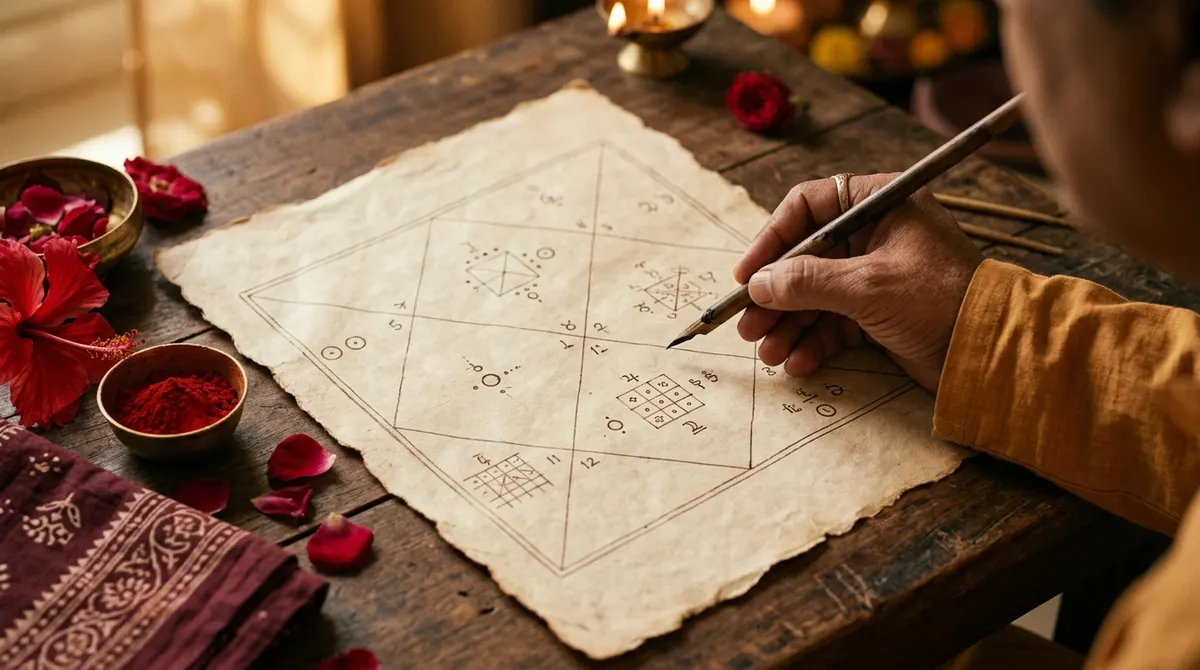
Mangal dosh nivaran refers to the traditional remedies undertaken when a kundli (birth chart) shows Mangal dosh — the placement of Mangal (Mars) in certain houses that Jyotish treats as requiring extra care. Also called Manglik dosh in common usage, it is a concept of the Jyotish tradition: Mangal is the planet of energy, courage and assertion, and when it sits in specific houses its influence is believed to add intensity to the areas those houses govern. It is a chart factor to be weighed, not a verdict of misfortune, and it appears in a significant share of all charts.
Nivaran means relief or remedy. When an astrologer identifies Mangal dosh, families commonly consider options such as Mangal Shanti puja, regular Hanuman worship, mantra japa, fasting and charitable giving. Before any of that, the most important step is the reading itself — a qualified astrologer should read the full kundli before any remedy is suggested, because cancellation rules, house strength and the running dasha (planetary period) all change the interpretation. Nothing in this tradition guarantees outcomes; the remedies are acts of devotion and discipline described in classical texts and followed by families for generations.
Want this ritual done the authentic way?
Get Your Kundli Checked (Vedic Life Audit)How Mangal Dosh Is Identified in a Kundli
Identification is a matter of house placement from specific reference points. In the North Indian tradition most commonly followed in Hindi-speaking regions, Mangal dosh is checked from the lagna (ascendant) and often also from Chandra (the Moon sign); some families additionally check from Shukra (Venus).
Regional variation is significant here: South Indian traditions check dosh primarily from Chandra lagna, and some schools weigh it by the pada (quarter) of the nakshatra Mangal occupies. A dosh in the 1st or 7th house is generally given more weight than one in the 12th, and one seen from both the lagna and the Moon is considered stronger. This is why an online calculator gives only a rough indication — the placement of every other planet matters just as much as Mangal's position alone.
If Mangal occupies any of the houses listed below from these reference points, the dosh is said to be present:
- 1st house (lagna) – the self, body and temperament.
- 2nd house – family, speech and accumulated wealth.
- 4th house – home, mother, property and inner peace.
- 7th house – marriage and partnerships, the placement most discussed in marriage matching.
- 8th house – longevity, shared resources and sudden changes.
- 12th house – expenditure, foreign connection and spiritual liberation.
Commonly Cited Cancellation Conditions
Classical Jyotish texts describe conditions under which Mangal dosh is considered reduced or cancelled — often called cancellation or bhanga rules. Their application differs between schools, so they should never be applied by a layperson alone: the final call belongs to the astrologer reading your full chart. A Vedic Life Audit gives you a structured, calm reading of the kundli rather than a single-label verdict. The commonly cited conditions include:
- Mangal in its own houses — Mesha (Aries) or Vrishchik (Scorpio) — is commonly treated as a weaker dosh.
- Mangal in exaltation (Makar/Capricorn) is traditionally considered to act more benignly.
- A benefic aspect, especially from Guru (Jupiter), is widely cited as reducing the dosh.
- The dosh being present identically in both partners' charts is traditionally said to offset each other during marriage matching.
- If Mangal sits in a house some schools do not count for dosh, or the chart otherwise shows strong benefic support, many astrologers treat the dosh as non-effective.
- When the dasha periods of the relevant planets have already passed, the practical influence is often judged minimal.
Mangal Shanti Puja: The Primary Traditional Remedy
When Mangal dosh is confirmed and a remedy is advised, Mangal Shanti puja is the most commonly prescribed ritual for mangal dosh nivaran. It is a puja dedicated to propitiating Mangal and can be performed as a standalone ceremony or as part of a broader Navgrah Shanti puja. Families often schedule it on a Tuesday (Mangalvar), which is traditionally Mangal's weekday, or at a muhurat chosen from the panchang. The vidhi below reflects the sequence commonly followed in North Indian homes; your pandit will adjust it to your family custom:
- Snana and achaman: ritual purification of the space and participants.
- Ganesh Pooja: invoking Lord Ganesh to remove obstacles from the ceremony.
- Kalash Sthapana: establishing the kalash (sacred water pot) with mango leaves and coconut.
- Sankalp: stating intention — names, gotra if known, place, date and the purpose of the puja.
- Mangal Avahan and worship: inviting Mangal and offering red flowers, red cloth and tilak.
- Mangal mantra japa: chanting the well-known bija mantra on a mala a prescribed number of times — ॐ अं अंगारकाय नमः (Om Ang Angarakaya Namah).
- Havan: offering ghee and samagri into the sacred fire with repeated mantras.
- Aarti, prasad and dakshina: closing the ceremony and distributing prasad to the family.
What Samagri You Will Need
Samagri means the materials and offerings gathered for a ritual. For Mangal Shanti puja it usually includes a kalash, red cloth, red flowers (hibiscus or red lotus where available), coral-coloured kumkum, rice, akshat, havan samagri, ghee, incense, a diya and a mala for the japa. Divyanushthan pandits can supply a complete written samagri list for any mangal dosh nivaran ceremony and arrange everything in advance.
One caution on materials: if a gemstone is prescribed at all, it is traditionally worn only on a qualified astrologer's advice after a full reading of the kundli — never bought off the shelf as a generic remedy. The same applies to expensive idols or “powerful” items sold with urgent claims. Genuine tradition asks for simple, sincere offerings, not purchases.
Hanuman Worship and Other Traditional Practices
Alongside or instead of a formal puja, several devotional practices are traditionally recommended for Mangal dosh nivaran. These are simple, inexpensive and can become part of a family's regular routine rather than a one-time event:
- Tuesday observance: fasting or a light vegetarian diet on Mangalvar, breaking the fast after evening Hanuman pooja.
- Hanuman Chalisa recitation: reading the Chalisa on Tuesdays; many families also recite it on Saturdays, as Hanuman worship is traditionally associated with easing Shani-related strain as well.
- Hanuman mantra japa: ॐ हं हनुमते नमः (Om Ham Hanumate Namah), chanted with a mala on Tuesdays.
- Donation (dana): traditionally offering red lentils (masoor dal), red cloth, jaggery or copper items on Tuesdays, given quietly and without fanfare.
- Navgrah path or Rudrabhishek: extended mantra recitation or a Shiva abhishek performed when a pandit advises a larger observance.
- Household discipline: the tradition emphasises controlling anger and practising patience, since Mangal governs assertion — the inner remedy matters as much as the outer one.
What Families Can Realistically Expect
In traditional belief, Mangal Shanti puja and regular Hanuman devotion are said to soften the difficulties attributed to Mangal dosh and strengthen qualities like courage, focus and self-control. Families commonly report a sense of relief and togetherness after performing the ceremony — the ritual gathers relatives, elders give blessings, and everyone participates in a shared act of faith. These are traditional beliefs, passed down through generations, and should be understood as such.
No puja can guarantee a happy marriage, a specific career result or any other worldly outcome, and no remedy substitutes for clear communication, sound judgement or professional advice on medical or legal matters. Jyotish itself teaches that planetary influence is one factor among many, shaped by effort and conduct. If anyone pressures you with fear-based claims about Mangal dosh or tries to sell expensive items as urgent remedies, treat that as a warning sign rather than tradition.
Practical Checklist Before Acting on a Reading
Use this checklist before committing to any mangal dosh nivaran programme:
- Get the full kundli read by a qualified astrologer — never rely on a single-factor online result
- Ask specifically whether any cancellation conditions apply in your chart
- Note which reference points (lagna, Moon, Venus) your tradition and astrologer use
- Fix the muhurat with the pandit before buying samagri or inviting family
- Request a written samagri list and arrange it a day in advance
- Decide the scale — a simple home puja versus an extended jaap with havan
- Turn the Tuesday observance into a sustainable habit rather than a one-off
- Decline any gemstone or costly item not justified by a full reading
Why an Experienced Pandit Matters
Mangal dosh sits at the intersection of Jyotish interpretation and ritual practice, and both halves require experience. On the reading side, a good astrologer distinguishes a real dosh from a cancelled one and explains it without frightening anyone — no small skill when families are anxious about marriage matching. On the ritual side, an experienced pandit performs the sankalp correctly, keeps the japa count accurate, and follows the vidhi in the right sequence from kalash sthapana to aarti.
Divyanushthan helps families do this in the right order. Start with the Vedic Life Audit, a kundli-based guidance report that lays out the chart calmly and in plain language, so you understand what is actually present before any remedy is discussed. If a Mangal Shanti puja or other observance is advised, our verified Vedic pandits can guide your family through every step and help arrange the samagri — no fear-based upselling, no exaggerated claims, just tradition practised properly.
Want this ritual done the authentic way?
Get Your Kundli Checked (Vedic Life Audit)Frequently Asked Questions
What is Mangal dosh and how is it identified?
Mangal dosh is the placement of Mangal (Mars) in the 1st, 2nd, 4th, 7th, 8th or 12th house from the lagna — and, in many North Indian traditions, also from the Moon sign. A qualified astrologer confirms it from the full kundli, since other planets can weaken or cancel it.
Is Mangal dosh always a problem for marriage?
No. It is a chart factor traditionally weighed during marriage matching, not a verdict. Many traditions hold that matching dosh present in both charts offsets it, and cancellation conditions frequently apply. A full reading — not a label — is what matters.
What is the main remedy for Mangal dosh?
Mangal Shanti puja, performed with sankalp, mantra japa of the Mangal bija mantra and a havan, is the most commonly prescribed ritual. Many families also follow Tuesday fasting, Hanuman Chalisa recitation and traditional donations as ongoing practice.
Can I check Mangal dosh online myself?
Online calculators give a rough indication based on house placement alone. They usually cannot account for cancellation rules, which reference points your tradition uses, or the strength of other planets — so treat any online result as a starting point, not a conclusion.
Do I have to wear a gemstone for Mangal dosh?
Not necessarily, and never buy one as a generic remedy. If a gemstone is indicated at all, it is traditionally prescribed only after a qualified astrologer reads the full kundli and confirms it suits your chart.
Does performing Mangal Shanti puja guarantee results?
No. No ritual carries guaranteed outcomes. In traditional belief the puja propitiates Mangal and supports qualities like patience and courage, but results are understood as a matter of faith and personal effort, never a promised result.
Related guides
 RitualsGriha Pravesh Pooja Vidhi: Steps for New HomeA clear step by step guide to griha pravesh pooja vidhi for entering a new home with Vedic prayers, havan, and family participation.7 min read
 RitualsGriha Pravesh Samagri List: Full ChecklistA practical griha pravesh samagri list with everything for kalash, pooja, havan, and kitchen customs, plus packing and shopping tips.7 min read
 RitualsSatyanarayan Katha Vidhi: Complete GuideA simple guide to satyanarayan katha vidhi with preparation, pooja steps, story meaning, and prasad tips for families.7 min read